Stop Guessing.
Start Attesting.
Never trust critical enterprise analytics to probabilistic guesses. CxDM Platform bridges enterprise databases and LLMs using open OKF standards, AST guardrails, and deterministic verification.
SELECT nation, SUM(net_revenue) AS total_revenue
FROM analytics.fct_sales
WHERE fiscal_year = 2025 AND tenant_id = :current_tenant
GROUP BY nation;The Paradigm Shift: From Storage to AI-Ready Context
Classical data modeling was invented decades ago with a single primary mission: to store and organize data efficiently. Contextual Data Modeling (CxDM) builds directly on top of physical databases to model data specifically for deterministic AI querying.
Conceptual Model
Defines high-level business entities and their relationships (Customer, Order, Account). Focuses on business domain boundaries.
Logical Model
Details entity attributes, normalization (3NF/Star Schema), relationships, and primary/foreign key structures without engine specifics.
Physical Model
Optimized for disk & memory storage: data types, partitions, B-Tree indices, tablespaces, and engine dialect constraints.
Contextual Model
Constructed atop physical assets. Encompasses semantics, computation logic, AST constraints, and golden evaluation proofs for AI querying.
Why Classical Modeling is Not Enough for LLMs
Databases store tables, foreign keys, and indexes, but they do not store business intent. A column named net_amt does not declare how discounts are calculated, which tenant filter is mandatory, or which join requires conditional business predicates.
CxDM bridges this semantic gap. By packaging domain knowledge as versioned, auditable Git bundles (OKF v0.2), the AI model receives deterministic boundaries rather than unbounded guessing freedom.
Physical Schema + Prompt → LLM Guesses Query → Unchecked Execution
Physical Model + Meaning + Rules + AST Constraints + Proof → Deterministic SQL
The 4 Pillars of Contextual Data Modeling
Every CxDM knowledge bundle is structured around four deterministic facets.
Meaning — What is it?
Maintained under open Open Knowledge Format (OKF v0.2) specification as Git-native concept files, glossaries, schemas, and descriptors. Zero vendor lock-in.
Rules — How is it computed?
Attested Computation architecture. Verified financial calculations are never rewritten from scratch by AI; the model strictly discovers verified formulas and binds typed parameters.
Constraints — What is permitted?
AST Guardrails by Design. Generated SQL is syntactically parsed via sqlglot prior to execution: enforcing read-only, table allowlists, row limits, and mandatory predicates.
Proof — How accurate is it?
Continuous Evaluation Quality Gates. Golden question test suites run against every changeset and candidate release; unverified models or regressing accuracy are automatically blocked from publication.
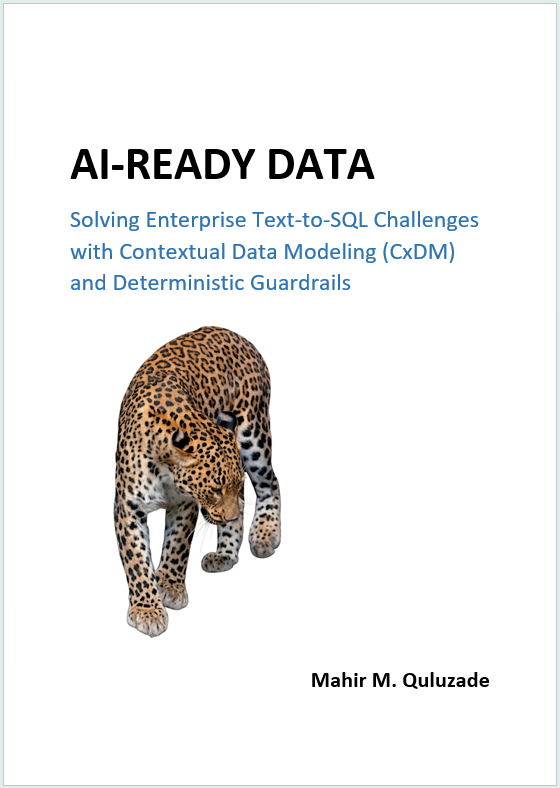
AI-READY DATA
Solving Enterprise Text-to-SQL Challenges with Contextual Data Modeling (CxDM) and Deterministic Guardrails
Drawing from over 22 years of hands-on database administration, enterprise Data Lakehouse architectures, and critical financial data systems, this technical book establishes the definitive framework for eliminating Text-to-SQL hallucination through deterministic contextual modeling.
Why does traditional Text-to-SQL fail in enterprise?
Standalone LLM SQL generation is inherently insufficient for trustworthy enterprise analytics.
Probabilistic Hallucinations
In complex business domains and multi-table joins, LLMs generate what looks plausible, not what is correct. Numbers change daily.
Data Leaks & Exposure
Traditional tools send customer data samples to third-party LLMs and execute unvetted, arbitrary SQL queries against internal databases.
Zero Audit & Transparency
No deterministic lineage behind AI outputs. Enterprises cannot verify which exact business rule was executed or prove compliance.
Enterprise-Grade Security Architecture
Built from the ground up to comply with strict central bank, fintech, and enterprise audit standards.
Zero Data to AI
Only schemas and contextual metadata reach the LLM. Enterprise records never leave your network boundary.
User-Scoped Execution
Queries execute strictly using the end-user's DB credentials. The AI cannot access what the user lacks permissions for.
Git-backed Audit Lineage
Changes governed via Git branches and MR approvals. Every answer is deterministically tied to a specific bundle@sha.
100% On-Premise
Complete air-gapped deployment via Docker/Kubernetes with private local LLM runners (vLLM/Ollama).
Bring Deterministic AI to Your Enterprise Data
Schedule a technical deep dive and discover how CxDM makes enterprise Text-to-SQL auditable, safe, and reliable.